Knowledge Bus: An Unlikely Idea To Fix Knowledge Work
On knowledge work at scale, cognitive accessibility, and the approach I’m exploring with Knowledge Bus.
I’ve been thinking about how collaborative knowledge work, which I’d argue already had scaling issues before AI, has now reached a state of complete and utter entropy.
Getting humans on the same page was already objectively challenging and inconsistent at best, depending on the industry, field of work, or the general competencies of the ones you’re collaborating with. Now we’re having to keep armies of agents on the same page too??
Some of us have also begun to normalize terms like cognitive offloading and the acceptance of cognitive debt. An unfortunate yet predictable consequence as AI lets us produce more documentation and code, faster, but keeping the reasoning behind the results clear and current still takes work.
And in my experience, corporate dynamics aren’t helping either. There was this Reddit post I came across where someone described it along the lines of how senior leadership and execs tend to pursue the new shiny, attention-grabbing things (now AI, previously things like cloud, CRMs, fancy dashboards, etc). Attention leads to bonuses and promotion. Improving information architecture and infrastructure is dull and boring. Documentation becomes scattered, duplicated, and stale. Most information inevitably gets stored in emails, shared network drives, intranet sites, and tools like OneNote and SharePoint. It’s a systemic issue, never just one person.
Then there’s the slop issue. Outputs from knowledge work are typically framed around the stakeholders involved, their fields of work, and the decisions they’re looking to make. AI tends to assume where it shouldn’t, and hedge varied thoughts when it’s time to preserve directional intent. You end up with grammatically safe, verbose AI slop that is unpleasant to read at best, and at worst can mislead or fail to enable downstream decisions.
Lastly, individual differences in cognition. Cognitive accessibility is a challenge that predates AI. It’s recognising barriers and design choices affecting people’s ability to use information. These differences span how information reaches someone (written words, hearing speech, etc), how it’s internally represented (words, imagery, spatial relationships, etc), the cognitive operations performed on the information (reasoning, memory, comparisons, planning, problem solving), and how the results are expressed (speech, prose, a diagram, symbolic notation, etc). Here, my current position is that LLMs and decision models have been a mixed bag. The ‘right’ set of defaults, skills, tools, agents for a person or team, even when it exists, isn’t constant. It shifts with time and context and requires periodic trial, exploration, and self-probing. That alone can already pose enough of a barrier for the vast majority of folks.
I hypothesize that cognitive accessibility is the primary bottleneck to realizing scaled knowledge work, and that solving for cognitive accessibility would address human-internal, human-collaborative, and human-agent knowledge work. Different backgrounds and ways of thinking bring valuable perspectives, but forcing everyone through the same narrow formats makes those perspectives harder to share.
So the idea I propose is an approach to structuring knowledge domains that:
- Is modular and work-agnostic enough to support arbitrary, overlapping areas of knowledge work.
- Doesn’t enforce truth across domains (i.e., domain-specific definitions of the same terms don’t conflict, yet can cross boundaries as needed).
- Treats both the context that determines what knowledge is needed and the conditions that shape how information is presented as first-class entities.
- Is succinct, human-readable, and epistemically honest and structured enough to support both system-2 models and system-1 models.
- Is FOSS. I believe it would be presumptuous to think that the foundation of such a concept could exist and flourish otherwise.
My attempt at realizing this idea is Knowledge Bus:
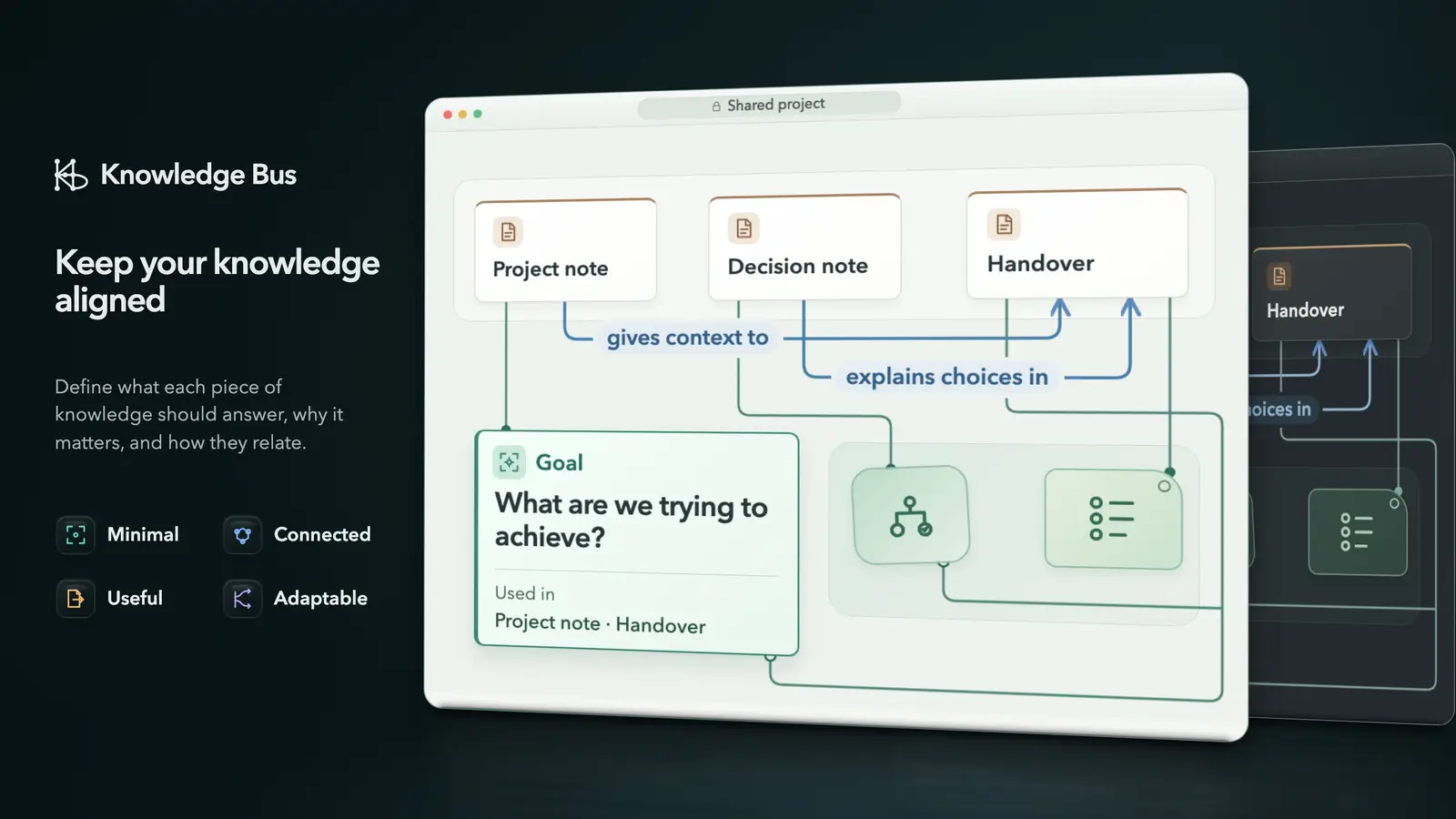
Knowledge Bus is a set of tools for humans and AI agents to define, structure, and connect knowledge. It allows you to codify arbitrary areas of knowledge work into modular specifications that can sit at the root of your knowledge base or inside nested folders. I created some example specs for common knowledge work including product development and codebase recordkeeping (READMEs, change descriptions, release notes, etc).
Currently, I’m planning example specs for data science projects and scientific research. I’m also exploring a dedicated spec for human cognition and accessibility.
To help dogfood the project, I also created a minimal MCP server that wraps Knowledge Bus and filters my personal notes and docs through relevant specs as I ask, write, and review.
At the time of writing, I would still describe Knowledge Bus as an unpolished proof of concept at best. Who knows what the future holds. In the mean time however, I’m having fun trying things out and exploring these various disciplines.